
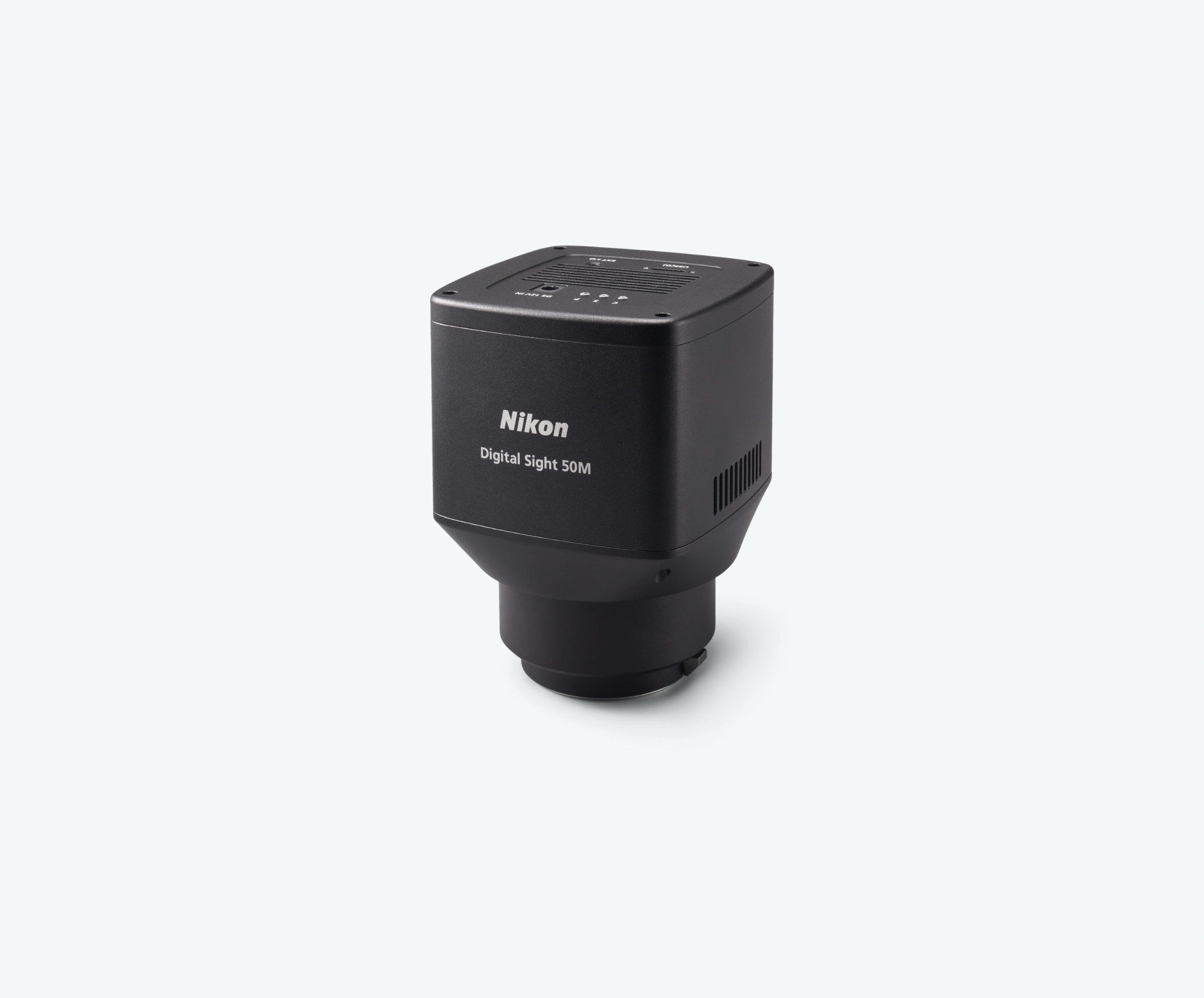
Nikon Digital Sight 50M is a 60-megapixel cooled monochrome CMOS camera optimized for microscope workflows, featuring a full-frame FX-format sensor (35.8 x 23.8 mm, 9552 x 6336 pixels at 3.76 µm pitch) for wide FOV screening, high-resolution analysis, and efficient large-volume sample imaging like well plates. With peak quantum efficiency of 85% (500 nm), ultra-low readout noise (6e-), dark current (1.0e-/p/s), and full well capacity (45,000e-), it captures faint fluorescent signals with minimal noise in 14-bit depth, supporting exposure times from 150 µsec to 120 sec and live rates up to 225.9 fps (ROI 640×480, 3×3 binning). F-mount compatible and integrated with NIS-Elements software for automated acquisition, time-lapse, photometry, and high-throughput screening, it enhances drug discovery, academic research, and quantitative fluorescence applications.
Key Features of Nikon Monochrome Microscope Camera — Digital Sight 50M
-
Ultra‑High Resolution
- Captures nearly double the area compared to conventional optics.
- Maximizes large‑format CMOS camera sensors for high‑throughput imaging.
-
Large Field of View
- Actual field of view of 7 mm with a 2× objective lens.
- Supports FOV25 observations with Nikon FX format CIS sensor.
- Efficient for imaging entire wells in multi‑well plates.
-
High Sensitivity & Low Noise
- QE peaking at 85%
- Detects faint fluorescent signals with minimal noise.
- Read noise as low as 6e‑, dark current of 1.0e‑/p/s, enabling clean 14‑bit fluorescence images.
-
Fast Imaging & ROI Capture
- Maximum frame rate of 225.9 fps for high‑speed acquisition.
- 6 fps at full resolution (60 MP) and 27 fps at 6.7 MP.
- ROI mode allows rapid imaging of selected regions for dynamic studies.
-
Software Integration
- Works with NIS‑Elements HC software for automated well‑plate screening.
- Provides workflows from well selection to ROI detection and analysis.
- Generates heat maps, graphs, and quantitative data for high‑content imaging.
-
Time‑Lapse & Fluorescence Imaging
- Stable cooled sensor supports long‑term time‑lapse experiments.
- Optimized for fluorescence imaging with low noise and high sensitivity.
- Fast focusing even under fluorescence conditions


