Numerical Aperture (NA) and Resolution in Microscopic Imaging

In this tutorial, a perfect, aberration-free microscope objective forms at the intermediate image plane a diffraction image known as the Airy pattern, generated by spherical waves passing through the rear aperture and converging at the focal point. The three-dimensional Airy pattern is symmetrically periodic along the optical axis and radially in the image plane; a focal-plane section reveals a bright central Airy disk surrounded by concentric bright and dark rings, of which usually only a few are visible because higher orders are lost in stray light.

The interactive tutorial uses a Numerical Aperture slider (NA = 0.20–1.30) to show how increasing objective NA reduces the size of the Airy pattern and its central peak, thereby improving image resolution in both the two-dimensional viewport and a three-dimensional point spread function display. As the slider moves from low to high NA, initially blurred, fringe-dominated features become sharper, more rings appear, and at the highest NA the diffraction disks separate into distinct bright points each encircled by diminishing rings.

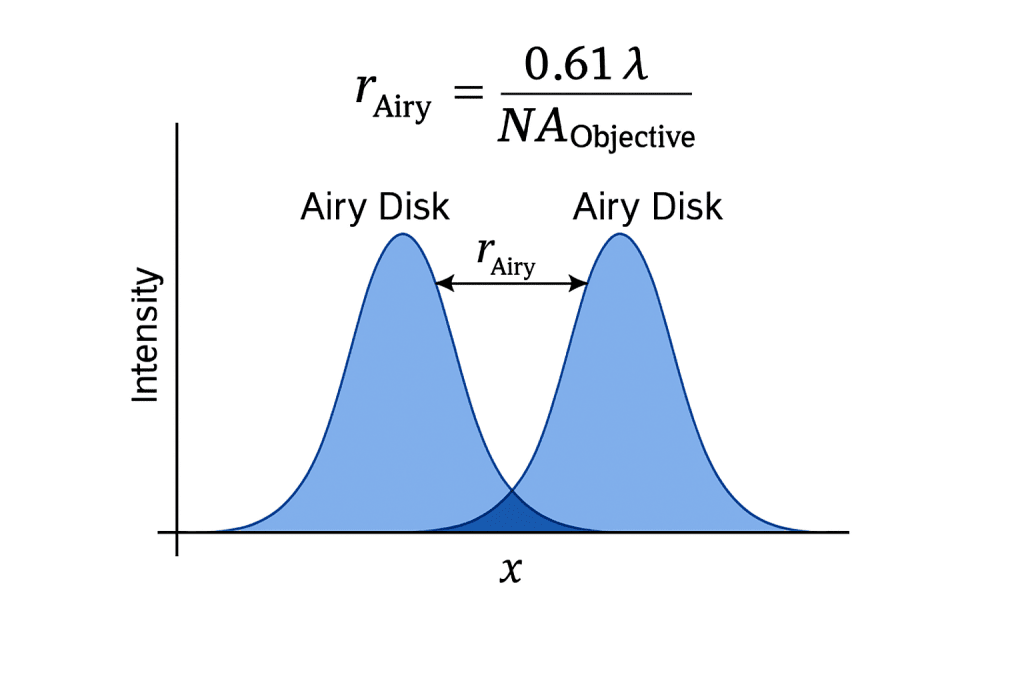
The resolving power of the objective is set by diffraction and depends on wavelength and numerical aperture. The Airy radius from the central maximum to the first minimum is

while the numerical aperture is

NAobj = nsin(θ)

where n is the refractive index of the medium between specimen and objective and θ is the half-angle of the light cone. The image resolution D is commonly written as

D=0.61λ / NA

so that smaller D values (achieved by higher NA or shorter wavelength) correspond to higher resolution, exactly the trend visualized as the NA slider is increased in the tutorial.