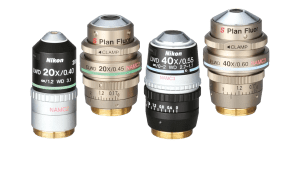
A Guide to Nikon Objective Lenses
Microscope manufacturers produce many specialized objectives for different imaging methods, cover glass thicknesses, and working distances, and their function is not obvious from appearance. Finite objectives form a diffraction‑limited image at a fixed plane set by tube length, often relying on matched eyepieces or tube lenses for residual corrections. Modern systems use fully corrected, infinity‑corrected objectives that send parallel rays to a tube lens, which forms the intermediate image. Infinity and finite objectives are not interchangeable and are usually brand‑specific. Objective barrels list key specifications such as magnification, numerical aperture, corrections, tube length, and intended medium.
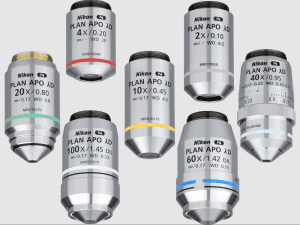
Magnification and Color Code
Magnification tells you how many times the objective enlarges the specimen (e.g., 4x, 10x, 40x, 100x).
Typical color rings help you recognize magnification at a glance:
-
Black: 1x
-
White: 2x
-
Red: 4x
-
Yellow: 10x
-
Green: 20x-25x
-
Light blue: 40x-50x
-
Cobalt/dark blue: 60x
-
White: 100x and above
Optical Corrections
Achromat
-
Basic, general‑purpose objective; most common in teaching and routine microscopes.
-
Corrected for two wavelengths (typically blue and red) in axial chromatic aberration and partially for spherical aberration.
-
Field flatness is limited; image is sharp in the center but softens toward the edges (unless combined with “Plan”).
-
Good for brightfield and simple imaging where absolute color accuracy and edge‑to‑edge sharpness are less critical.
Fluor (Fluorite / Semi‑Apochromat)
-
Intermediate‑performance objective, often labeled Fluor, Fluorite, or Plan Fluor.
-
Uses special “fluorite” glass with low dispersion, giving better correction of spherical and chromatic aberrations than achromats.
-
Typically higher numerical aperture than achromats at the same magnification, so better resolution and brightness.
-
Widely used for fluorescence, live‑cell imaging, and applications needing good color correction and contrast but not the highest possible correction.
-
Often available as “Plan Fluor,” which also gives a flat field across the image.
Plan Apo (Plan Apochromat)
-
High‑end, research‑grade objective with the highest level of correction.
-
“Apo” (apochromat) means corrected for three or more wavelengths in chromatic aberration and carefully corrected for spherical aberration, giving very accurate color and sharpness.
-
“Plan” indicates a flat field across nearly the entire field of view, so structures at the edge are in focus like those in the center.
-
Typically has high NA, excellent contrast, and minimal residual aberrations, making it ideal for quantitative imaging, confocal microscopy, multi‑color fluorescence, and high‑resolution work.
-
More complex and expensive due to sophisticated glass types and designs.
Numerical aperture (NA)
Numerical aperture measures how much light the objective can gather and how finely it can resolve detail.
Key ideas:
-
Higher NA → better resolution and brighter image, but shallower depth of field.
-
Low‑power objectives (4x, 10x) usually have low NA (around 0.1–0.25).
-
High‑power dry objectives (40x) might reach NA ~0.65–0.75.
-
Oil immersion objectives can reach NA ~1.25–1.40 because oil has a higher refractive index than air.
Some objectives include an iris diaphragm (often labeled “Iris” or similar) that lets you reduce effective NA to increase depth of field or improve contrast for specific techniques.
Working distance
Working distance (WD) is the distance from the front lens of the objective to the specimen when the image is in focus.
Main points:
-
As magnification and NA increase, WD usually decreases.
-
Low‑power objectives can have WDs of several millimeters to centimeters.
-
High‑NA 100x oil objectives may have WDs well below 0.2 mm.
Special designs extend this distance and are often labeled:
-
LWD: long working distance
-
ELWD: extra‑long working distance
These are useful for thick samples, live cells in dishes, or when you must avoid contacting coverslips or equipment (e.g., micromanipulators).
Intended medium (immersion type)
Objectives are designed to work with a specific medium between the front lens and the coverslip/specimen. Common labels:
-
Air : normal “dry” objectives. (no label or simply absence of immersion marking)
-
Oil: “Oil”
-
Water: “W,” “WI.”
-
Glycerol: “Glyc” for intermediate refractive index between water and oil.
-
Silicone Oil: “SIL”
Why it matters:
-
The medium’s refractive index affects NA and aberrations.
-
Using the wrong medium (e.g., oil instead of water) severely degrades resolution and contrast, even if you can still focus.
-
Some advanced objectives are labeled for multi‑immersion use and may combine medium markings with an adjustable NA or correction collar.
Understanding these markings ensures you choose the right objective for your imaging method, sample geometry, and resolution needs.
Correction ring (Correction Collar)
A correction ring (or correction collar) is a rotating ring on the objective that lets you adjust for variations in coverslip thickness and sometimes for imaging in different media.
How it works:
-
Many high‑NA objectives are designed for a standard coverslip thickness of 0.17 mm.
-
Real coverslips vary (e.g., 0.13–0.21 mm), which can introduce spherical aberration and blur.
-
The correction ring changes the relative position of internal lens groups to compensate for this variation.
Usage:
-
You adjust the ring while watching image sharpness and contrast, often using fine features like small organelles or fine lines.
-
Objectives with a collar would have a scale showing thickness range (e.g., 0.11–0.23).
This adjustment is critical for quantitative imaging, thick samples, or high‑resolution work.
Application markings
Barrel markings also indicate which imaging technique the objective is optimized for. Common examples:
-
Phase contrast: PH, Phase, Ph1/Ph2/Ph3, DL, DM, etc.
-
Differential interference contrast: DIC, NIC (Nikon Advanced Modulation Contrast).
-
Polarization: Pol.
These markings tell you not just that the objective will form an image, but that it is optimized for contrast, aberrations, and coatings appropriate to a specific technique.